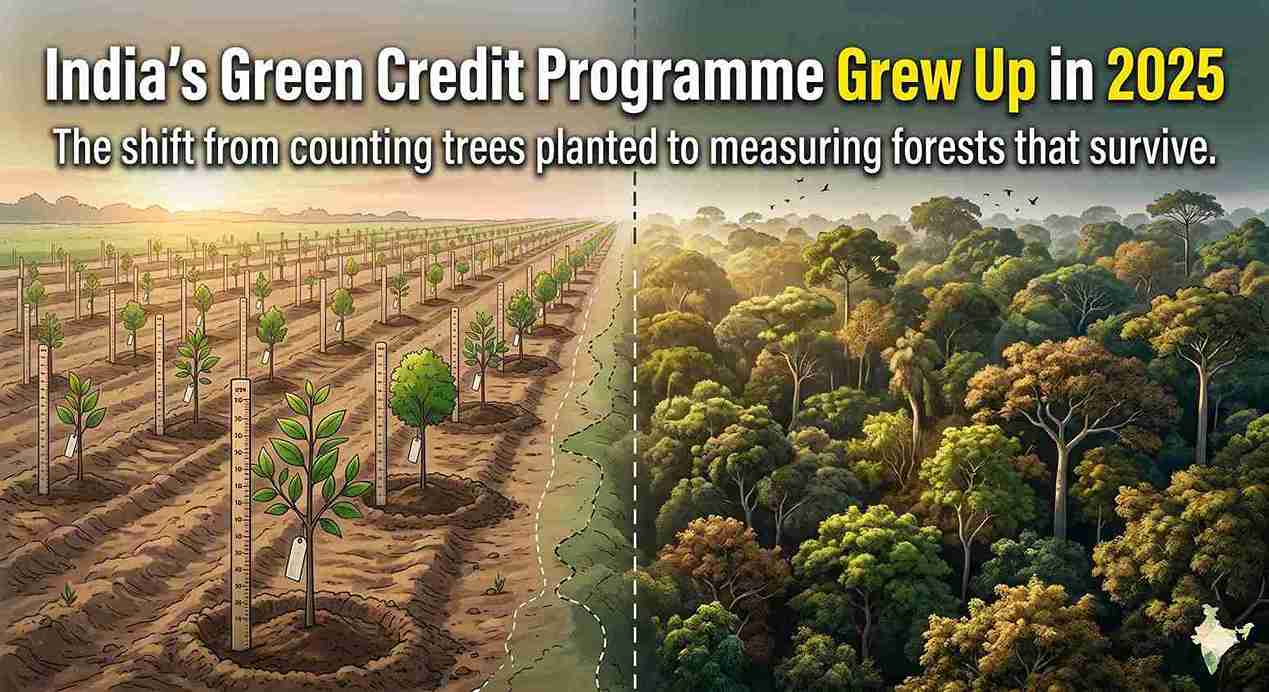
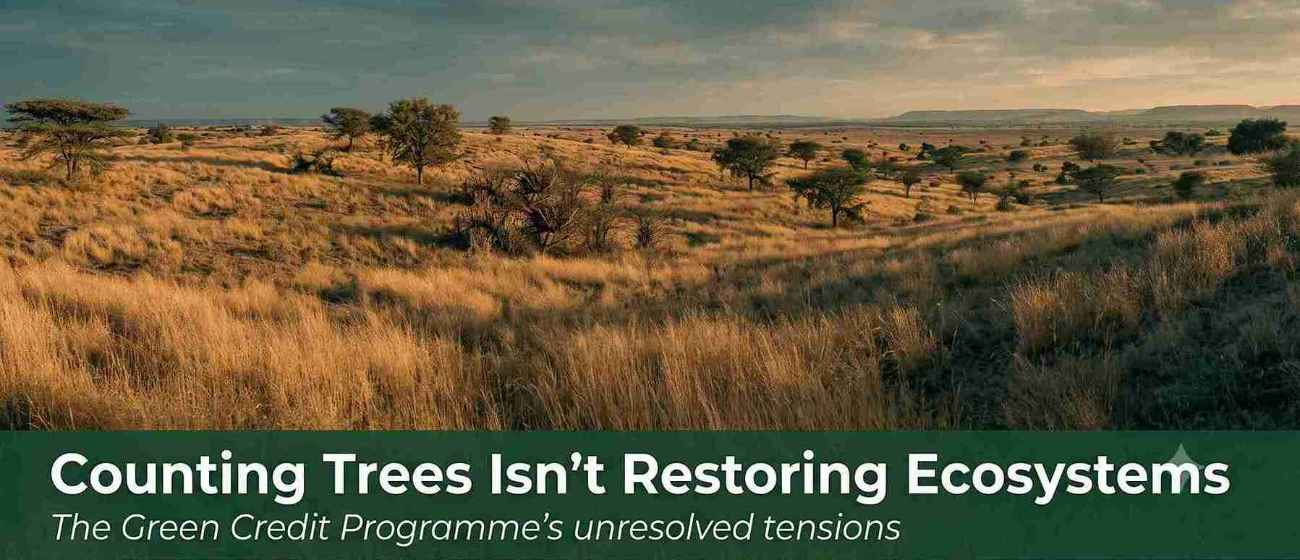
The Green Credit Programme has quietly resolved into a single countable unit: one credit for each surviving tree older than five years, on land classified as degraded, released only once canopy density crosses 40 percent (MoEFCC, 2025). It is a clean metric – auditable, geo-taggable, hard to fake at scale. It is also where every unresolved tension in the Programme begins, because a tree count is not an ecological outcome, and the distance between the two is exactly where the instrument strains.
Earlier in this series we set out what the 2025 reforms changed, and what they now ask of companies entering the Programme. This piece takes the critical read. The rules are clear enough; the question is whether the instrument measures the thing it promises to deliver. Two tensions matter most to anyone weighing GCP participation. One is ecological – whether the land being planted should be planted at all. The other is accounting – whether the same trees end up claimed more than once. Both run back to the same root: the Programme measures what is easy to count.
Key Takeaways
- The Green Credit Programme has narrowed to one countable unit – a surviving tree older than five years, gated on 40% canopy density – and a tree count is not an ecological outcome.
- Much land mapped as “degraded forest” is in fact open natural ecosystem. India’s semi-arid ONEs cover ~320,000 km² (10% of the land surface), with under 5% protected (Madhusudan and Vanak, 2022).
- These are ancient biomes, not failed forests: fossil-pollen records trace open tree-grass systems back around four million years. In Banni, Asia’s largest tropical grassland, the highest soil carbon sits in plots where an exotic tree planted for “green cover” was cleared back out, at 142.72 tC/ha (Bhan et al., 2025).
- The 40% canopy gate structurally selects against these ecosystems: they cannot meet it while remaining themselves.
- CAG audits of the state afforestation machinery GCP relies on show survival as low as 7.5% (Odisha) and 33.5% (Uttarakhand), against a 60–65% FRI benchmark.
- The accounting issue is double claiming and an additionality breach, not textbook double-counting – GCP doesn’t monetise carbon, but Rule 14(5)(i) means one planting can touch a green credit, a carbon credit and a compensatory-afforestation obligation at once.
What does “degraded land” actually mean under the Green Credit Programme?
Green credits are earned by afforesting “degraded” land, identified and executed by State Forest Departments. The category sounds neutral. In practice, a large share of what gets mapped as degraded forest in India is not degraded forest at all. It is open natural ecosystem (ONE): grassland, savanna, scrub, and the arid and semi-arid mosaics that range from sandy deserts and rock outcrops to open grasslands with scattered trees (Ratnam et al., 2011). The scale is not marginal. High-resolution mapping puts India’s semi-arid ONEs at roughly 320,000 km² – about 10 percent of the country’s land surface, and a third of Rajasthan – with under 5 percent of it inside the protected area network (Madhusudan and Vanak, 2022). Because significant tracts are officially classified as wasteland, they sit exactly where afforestation programmes go looking for land (Madhusudan and Vanak, 2022).
These are not failed forests waiting to be restored. They are ancient biomes. Fossil-pollen records show open-canopy tree-grass mixtures persisting across the subcontinent for thousands of years, shaped by gradual drying and a more seasonal climate from around four million years ago – not by recent forest clearing (Mongabay India, 2022). They hold much of their carbon below ground, in roots and soil rather than standing timber (Veldman et al., 2015). They carry endemic species found nowhere else, and they sustain the livestock economies of pastoralist communities – the Dhangar, Rabari, Kuruba and others (Madhusudan and Vanak, 2022).
India has already run this experiment, and the result is on record. The Banni grasslands in Kutch, at 2,300 km², Asia’s largest tropical grassland, hold 27.69 million tonnes of carbon in their soils, at an average density of 119.61 tC/ha (Bhan et al., 2025). Prosopis juliflora, an exotic tree, was introduced there in the 1960s for precisely the reasons afforestation is pushed today: control salinity, raise green cover. It now covers roughly half of Banni. And the plots holding the most soil carbon are not the wooded ones. They are the vaadas – sites where communities cleared the Prosopis back out – at 142.72 tC/ha, above the wetlands, the saline brushlands, and the Banni average (Bhan et al., 2025). The authors’ conclusion is blunt: adding trees to a tropical grassland does not add soil organic carbon. Sixty years on, what recovers the carbon is taking the trees away.
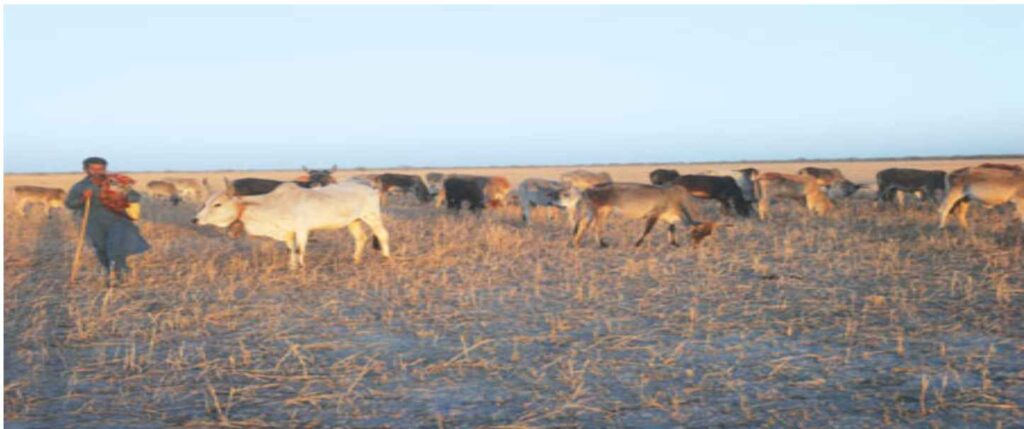
Planting trees on these systems does not add ecological value. It removes it. The soil is scraped, the seed bank destroyed, and fast-growing exotics such as eucalyptus, acacia, prosopis are put in the ground. From satellite altitude the result reads as new green cover. On the ground it is a monoculture that suppresses native regeneration, drops the water table, and erases a functioning ecosystem (Mongabay India, 2022). This is the single strongest ecological critique of the Programme, and it is not a fringe view: it is the settled position of India’s grassland ecologists.
Why is 40% canopy density the wrong metric for these ecosystems?
The 40 percent canopy threshold makes the problem structural rather than incidental (MoEFCC, 2025). To earn credits, a parcel must reach a defined tree-canopy density. An open natural ecosystem, by definition, cannot meet that bar while remaining itself. The metric does not merely fail to see grasslands; it actively selects against them. The only way to satisfy the gate on such land is to convert it into something it was never meant to be – the same push toward “productivity” that produced the wasteland classification in the first place (Madhusudan and Vanak, 2022).
Even where the land genuinely is degraded forest, canopy density and tree count are thin proxies for what a functioning ecosystem actually is. Biodiversity, soil health, hydrological function, below-ground carbon – none of these are captured by counting stems that clear a density line (Veldman et al., 2015). A dense, even-aged plantation of a single exotic species will pass. A recovering natural mosaic, patchier and slower, may not. The Programme can reward the ecologically poorer outcome, because that outcome is the one that counts more cleanly.
Table 1: Comparison – What a green credit measures vs. what restoration requires
| What the credit counts | What it captures | What ecological restoration also requires |
| Surviving trees > 5 years | Stem count that persisted | Native-species composition, not just stems |
| 40% canopy density | Overhead tree cover | Function suited to the ecosystem (a grassland shouldn’t need canopy) |
| “Degraded land” restored | A land-classification label | Verification that the parcel is truly degraded forest, not open natural ecosystem |
| Above-ground greening | Visible tree cover | Soil-carbon change and below-ground storage |
| One credit, one act | A single planting event | Assurance the same asset isn’t claimed across registries |
How reliable is tree survival under state-run afforestation?
The Programme has no survival record of its own — it is too new — so it leans entirely on the state afforestation machinery whose record is already on file, and that record is poor. Comptroller and Auditor General performance audits of state compensatory-afforestation authorities have found plantation survival as low as 7.5 percent in Odisha across 2016–17 to 2019–20, attributed to non-maintenance (CAG, 2024), and 33.5 percent in Uttarakhand for 2019–22 – against a Forest Research Institute benchmark of 60–65 percent – alongside findings that funds meant for afforestation were diverted to unrelated purchases (CAG, Uttarakhand CAMPA audit, 2024).
This is the gap between the credit and the tree. Green credits are issued on surviving trees (MoEFCC, 2025) — which sounds like a safeguard. But applicants fund restoration on land they never control, executed by departments whose survival numbers have repeatedly come in far below standard. If credits issue only on surviving trees, and survival is a fraction of what is planted, the deliverable volume is a fraction of what is promised — and the projects that quietly fail leave no one obviously answerable.
Is the Green Credit Programme enabling double-counting of carbon?
No — not in the strict sense, and the precise version is the one that matters, because loose language has muddied this debate. Textbook double-counting means selling the same tonne of CO₂ twice. The Green Credit Programme does not monetise carbon at all, so there is no tonne being sold. What it enables is something different, and arguably harder to see: the same physical asset drawn on for more than one claim at once.
The precise term is double claiming — claiming multiple forms of payment for different services rendered by the same asset (Mehra, cited in Mongabay India, 2024). The mechanism is explicit: Rule 14(5)(i) of the Van (Sanrakshan Evam Samvardhan) Rules, 2023 requires every entity registered for accredited compensatory afforestation to register on the Green Credit Registry, which makes the same afforestation activity eligible for green credits, while the Carbon Credit Trading Scheme offset mechanism permits dual participation with the GCP (SCC Online, 2026). One act of planting; a green credit for the planting, a carbon credit certificate for the sequestration, and a compensatory-afforestation obligation discharged.
The deeper problem underneath is additionality. The CCTS offset mechanism holds that activities mandated by law are not eligible – the whole point of an offset is that it would not have happened otherwise. Compensatory afforestation is mandated by law. When a mandatory obligation simultaneously generates voluntary green credits, that additionality principle is emptied out (SCC Online, 2026). The 2025 notification’s restrictions such as credits non-tradable, non-transferable, exchangeable once, do not resolve this, because both claims still draw environmental benefit from the same underlying activity (SCC Online, 2026). This is not a reputational footnote for a single buyer. It is a systemic gap in how the instruments interlock.
How could the Green Credit Programme be fixed?
None of this argues for abandoning the Programme. A national instrument that channels capital into ecological restoration is worth having. But three design corrections would move it from counting trees toward restoring ecosystems.
First, take open natural ecosystems out of the “degraded land” pool. The mapping already exists. A 30-metre-resolution national map of India’s arid and semi-arid ONEs has been published as open data, at 85 percent classification accuracy (Madhusudan & Vanak, 2022). Eligibility should exclude mapped ONEs by default, with the burden on the executing department to demonstrate a parcel is genuinely degraded forest rather than intact open ecosystem.
Second, supplement the canopy-density gate with ecosystem-appropriate metrics. Native-species composition, soil-carbon change, natural-regeneration rates, and hydrological indicators would let restoration of a grassland or a natural mosaic count on its own terms, rather than forcing every outcome through a forest-shaped threshold (Veldman et al., 2015).
Third, close the double-claiming gap at the registry. A single national ledger with a unique identifier per restored asset, and a retire-on-mint rule – once a tree’s benefit is claimed under one instrument, it is marked spent for the others – would let the systems interlock without stacking. The technology is not exotic: India’s carbon market registry already uses unique digital identifiers and project exclusivity rules for precisely this purpose (Carbon Market Network, 2026).
The real question
Strip it back and the pattern is consistent: the Green Credit Programme measures trees because trees are countable, not because trees are the outcome anyone actually wants. Until it measures ecological function, a participant is buying a number, not an outcome – and the two can diverge sharply, especially on the open ecosystems the metric quietly pushes toward conversion.
That gap is the work. Reading it well – knowing which parcels are genuinely degraded forest, what a credit does and does not represent, and where an afforestation claim will hold up under scrutiny – is what separates a defensible sustainability decision from an expensive one. It is the work we do at Edha.
Key Definitions:
Open natural ecosystem (ONE)
A non-forest natural system — grassland, savanna, scrub, arid and semi-arid mosaic — that is a stable, ancient biome in its own right, not a degraded or intermediate stage on the way to forest (Ratnam et al., 2011).
Canopy density
The proportion of ground shaded by tree crowns. GCP gates credit issuance at 40%; the metric is inherently forest-shaped.
Double claiming
Claiming multiple forms of payment for different services rendered by the same asset. Distinct from double-counting, which is selling the same commodity — a tonne of CO₂ — twice (Mehra, cited in Mongabay India, 2024).
Additionality
The principle that a credited action would not have happened without the credit. The CCTS offset mechanism excludes activities mandated by law — which is why compensatory afforestation generating voluntary credits is a problem.
Compensatory afforestation (CA)
Restoration required by law to offset forest diverted for non-forest use. Under the 15 September 2025 route (OM No. FC-11/104/2025), restored degraded land can substitute at a 2×–4× multiple of the diverted area.
About the Author
Punnia Viswan is Co-Founder and CEO of Edha Sustainability Solutions LLP. She holds an M.Sc. in Sustainable Development from the University of Surrey and brings over a decade of experience across agriculture and sustainability. Her work centres on ecological restoration, impact measurement and life-cycle assessment (SimaPro, ISO 14067), including biochar LCA research at London South Bank University and UNITAR certification in REDD+. At Edha she advises organisations on reading environmental instruments precisely – what a credit represents, where an ecological claim holds, and how to build restoration that measures function rather than counting stems.
FAQs
Not necessarily. A large share of land mapped as “degraded forest” is actually open natural ecosystem – grassland, savanna or scrub. India’s semi-arid open natural ecosystems cover roughly 320,000 km², about 10% of the land surface (Madhusudan & Vanak, 2022). These are ancient, functioning biomes that store much of their carbon below ground. Afforesting them can destroy ecological value rather than add it. In the Banni grasslands of Kutch, the highest soil organic carbon density (142.72 tC/ha) is found not under tree cover but in restored plots where the exotic Prosopis juliflora – introduced in the 1960s to raise green cover – was removed (Bhan et al., 2025).
Not in the strict sense. GCP does not monetise carbon, so no tonne of CO₂ is being sold twice. The real issue is double claiming – drawing multiple forms of payment for different services from the same asset (Mehra, cited in Mongabay India, 2024). Rule 14(5)(i) of the Van (Sanrakshan Evam Samvardhan) Rules, 2023 requires compensatory-afforestation entities to register on the Green Credit Registry, so one activity can be eligible for a green credit, a carbon credit certificate under the CCTS, and a compliance discharge at once. It also raises an additionality problem, because legally-mandated afforestation shouldn’t generate voluntary credits.
Canopy density measures overhead tree cover, which is a forest-shaped metric. An open natural ecosystem cannot meet a 40% canopy bar while remaining itself, so the threshold structurally selects against those ecosystems. Even on genuine degraded forest, canopy and stem count are thin proxies for biodiversity, soil health and hydrological function (Veldman et al., 2015).
Comptroller and Auditor General performance audits of state compensatory-afforestation authorities have found survival rates as low as 7.5% in Odisha (2016–17 to 2019–20) and 33.5% in Uttarakhand (2019–22), against a Forest Research Institute benchmark of 60–65%. GCP is too new for its own survival data, but it relies on the same delivery machinery.
Yes, with targeted design changes: exclude open natural ecosystems from the “degraded land” pool using the existing 30-metre-resolution national ONE map (Madhusudan & Vanak, 2022); supplement canopy density with ecosystem-appropriate metrics such as native-species composition and soil-carbon change; and close the double-claiming gap with a single registry using unique asset identifiers and a retire-on-mint rule.
References:
- Bhan, M., Misher, C., Hiremath, A., & Vanak, A. T. (2025). ‘Restoration maintains high soil carbon stocks in Asia’s largest tropical grassland’. Ecological Applications, 35(5), e70073. Available at: https://doi.org/10.1002/eap.70073
- Carbon Market Network. (2026). Carbon credit registries in India: The complete guide (ICM, Verra, Gold Standard, and more). Available at: https://carbonmarketnetwork.com/blog/carbon-credit-registries-india/
- Comptroller and Auditor General of India. (2024). Report of the comptroller and auditor general of India (Compliance Audit) for the year ended March 2022. Available at: https://cag.gov.in/uploads/download_audit_report/2024/chapter-4-066e1a6d3f3c283.66375435.pdf
- Comptroller and Auditor General of India (2024). Report of the comptroller and auditor general of India on functioning of compensatory afforestation fund management and planning authority for the year ended 31 March 2022. Available at: https://cag.gov.in/uploads/download_audit_report/2024/Report-No.-5-of-2024_PA-on-CAMPA_UK_English-067b7207df21da8.12397130.pdf
- Madhusudan, M. D., & Vanak, A. T. (2022). ‘Mapping the distribution and extent of India’s semi-arid open natural ecosystems’. Journal of Biogeography, 50, 1377–1387. Available at: https://doi.org/10.1111/jbi.14471
- Ministry of Environment, Forest and Climate Change. (2025). Green Credit Rules — revised methodology for tree plantation (notified 29 August 2025). Available at: https://ankurykftgupta.s3.cyfuture.cloud/gcc/dev/265796-cmf1ct68q000a0iym4th8fkn1.pdf
- Ministry of Environment, Forest and Climate Change. (2025). Office Memorandum No. FC-11/104/2025, dated 15 September 2025 — compensatory afforestation through green credits. Available at: https://ankurykftgupta.s3.cyfuture.cloud/gcc/dev/16-09-2025-guidelines-on-gcp-plantation-for-ca-2-P9ISq1LuCnRQy1JdGRX0.pdf
- Mongabay India. (2022). Restoring Indian grasslands does not require disturbing soil and planting grasses, but more science [Commentary]. Available at: https://india.mongabay.com/2022/08/commentary-restoring-indian-grasslands-does-not-require-disturbing-soil-and-planting-grasses-but-more-science/
- Mongabay India. (2024). Green Credit Scheme’s ‘methodology’ doesn’t inspire confidence among experts. Available at: https://india.mongabay.com/2024/03/green-credit-schemes-methodology-doesnt-inspire-confidence-among-experts/
- Ratnam, J., Bond, W. J., Fensham, R. J., Hoffmann, W. A., Archibald, S., Lehmann, C. E. R., Anderson, M. T., Higgins, S. I., & Sankaran, M. (2011). ‘When is a ‘forest’ a savanna, and why does it matter?’. Global Ecology and Biogeography, 20, 653–660. Available at: https://doi.org/10.1111/j.1466-8238.2010.00634.x
- SCC Online. (2026). Ecological concerns in India’s Green Credit Programme: A critical analysis of tree plantation modalities. Available at: https://www.scconline.com/blog/post/2026/02/11/ecological-concerns-green-credit-programme-india-analysis/
- Van (Sanrakshan Evam Samvardhan) Rules, 2023, Rule 14(5)(i). Government of India. Available at: https://forestsclearance.nic.in/writereaddata/Rules/VanSanrakshanEvamSamvardhanRules2023.pdf
- Veldman, J. W., Overbeck, G. E., Negreiros, D., Mahy, G., Le Stradic, S., Fernandes, G. W., Durigan, G., Buisson, E., Putz, F. E., & Bond, W. J. (2015). ‘Where tree planting and forest expansion are bad for biodiversity and ecosystem services’. BioScience, 65(10), 1011–1018. Available at: https://doi.org/10.1093/biosci/biv118
Join the Conversation
If you advise on afforestation or restoration: how are you checking whether a “degraded land” parcel is genuinely degraded forest and not an intact open ecosystem – before a green credit is ever claimed on it? We’d like to hear how practitioners are handling that call. Share this with a colleague working on GCP participation, and leave your read in the comments.
At Edha Sustainability Solutions, we work with organisations to read environmental instruments precisely – separating what a credit counts from what an ecosystem needs, and building restoration and disclosure that hold up under scrutiny. If your team is weighing a Green Credit Programme decision or an afforestation claim, write to us at contact@edhasustainability.com. We approach this as practitioners, not vendors.