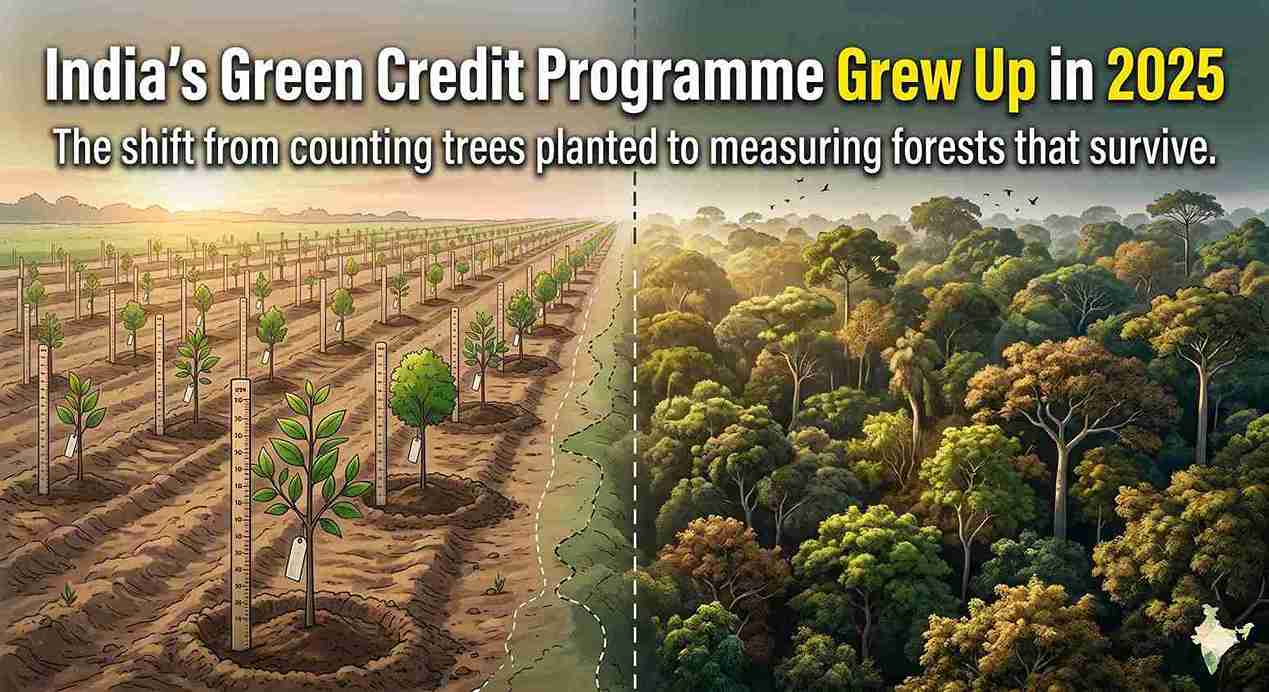
India’s Green Credit Programme changed in 2025: survival-based credits, an end to trading, and a new compensatory afforestation link. What it means.
Written by Punnia Viswan | Co-Founder & CEO, Edha Sustainability Solutions LLP | Last updated: 22nd June 2026 | All external links verified at the time of publication
India’s Green Credit Programme (GCP) is a national scheme that rewards voluntary environmental action, starting with tree plantation on degraded land, by issuing “green credits” for measurable ecological outcomes. In 2025 the programme was substantially rewritten. The revised rules shifted credits from rewarding saplings planted to rewarding trees that survive, ended the open trading of credits, and tied the programme to compensatory afforestation. For anyone working on conservation projects, corporate offsets, or ESG compliance, this was one of the more consequential policy moves of the year. Here is what shifted, and why it deserves more attention than it got.
Key takeaways
- The Green Credit Programme operates under the Environment (Protection) Act, 1986, and was notified on 12 October 2023.
- The revised methodology, notified 29 August 2025, issues one green credit per surviving tree older than five years, only after the site reaches 40% canopy density.
- Green credits are now non-tradable and non-transferable, except between a holding company and its direct subsidiaries, and can be used only once before being extinguished.
- From 15 September 2025, afforestation raised on degraded forest land under the programme can be used to meet compensatory afforestation obligations.
What is the Green Credit Programme?
The Green Credit Programme is a market-based instrument notified under the Green Credit Rules, 2023, and administered by the Indian Council of Forestry Research and Education (ICFRE) under the Ministry of Environment, Forest and Climate Change. It was notified on 12 October 2023 under the Environment (Protection) Act, 1986, as part of India’s Lifestyle for Environment (LiFE) movement. The aim is to reward voluntary environmental action rather than only penalise damage, and to build an inventory of degraded land that can be brought back under tree cover.
The first operational chapter, the tree plantation methodology of February 2024, let applicants claim credits relatively early, based largely on how many saplings were planted and at what density. It set a minimum of 1,100 trees per hectare. It was a reasonable way to get the programme moving, and it was also easy to game. High seedling mortality and thin long-term accountability meant a project could look successful on paper long before anyone knew whether the trees survived. The 2025 reforms were the response to that gap.
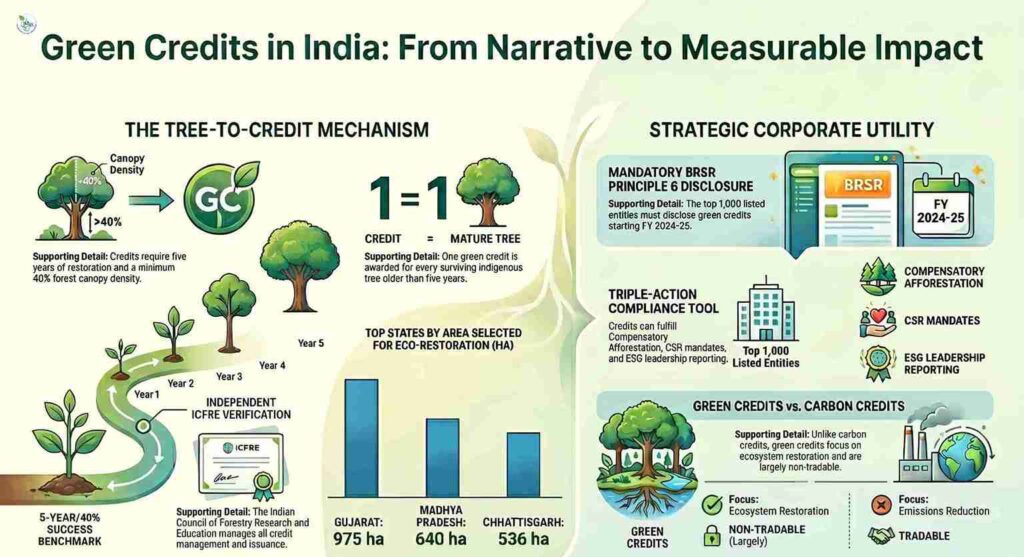
Fig 1: The Overview of India’s Green Credit Framework
What changed in the Green Credit Rules 2025?
The Green Credit Rules 2025 changed the programme along three lines: how a credit is earned, whether it can be sold, and what it can be used for. The table below summarises the shift.
| Dimension | 2024 methodology | Revised methodology (29 Aug 2025) |
| Basis of credit | Number of trees planted, minimum 1,100/hectare | One credit per surviving tree older than five years |
| Ecological measure | Planting density | Vegetation status and canopy density |
| Verification threshold | Count at planting | 40% canopy density before issuance |
| Project timeline | Early claims | Minimum five-year restoration before any credit |
| Tradability | Envisaged as tradable | Non-tradable; usable once, then extinguished |
| Primary use | Voluntary credit | Compensatory afforestation, CSR, ESG/BRSR, project compliance |
Change one: from saplings planted to trees that survive. The most important shift is philosophical, even though it shows up as technical detail. A credit is no longer a reward for planting. It is a reward for establishing a forest. Issuance now happens only after a minimum five-year restoration period and on reaching a 40% canopy density target, with one green credit awarded per surviving tree older than five years. Applicants are assessed on vegetation status rather than a headcount of seedlings. Notably, the rigid 1,100-trees-per-hectare rule was dropped, which ecologists welcomed because dense uniform planting damages grasslands and savannahs wrongly classed as “degraded.”
Change two: green credits are no longer a tradable commodity. When the programme was first conceived, green credits were imagined as a freely tradable instrument. The 2025 rules closed that door. Green credits are now non-tradable and non-transferable, with a narrow exception for transfers between a holding company and its direct subsidiaries. A credit can also be exchanged only once, after which it is extinguished and cannot be reused. The move is a deliberate strike against speculation and greenwashing: if credits cannot be bought and sold freely, they cannot become financial assets detached from the conservation work behind them.
Change three: green credits can now substitute for compensatory afforestation. In its 16 September 2025 guidelines (OM No. FC-11/104/2025), the Ministry allowed afforestation raised on degraded forest land under the programme to be used to meet compensatory afforestation requirements under forest law. This connects the GCP to one of the most demanding obligations in Indian forestry and gives the credit a concrete, high-stakes use case. It has also drawn criticism: analysts warn it risks letting restoration in one place justify forest diversion in another, a tension explored in detail by Mongabay. I’ll return to that debate in a later piece.
Are green credits tradable in India?
No. As of the 2025 methodology, green credits in India are non-tradable and non-transferable. The only permitted transfer is between a holding company and its direct subsidiaries, and any credit can be used only once before it is extinguished. This reverses the original design, which envisaged credits trading on an open market. What remains is the credit’s compliance utility: meeting Corporate Social Responsibility obligations, supporting ESG and BRSR disclosures, and satisfying compensatory afforestation requirements. India looked at a liquid green credit market and chose integrity over liquidity.
Why the 2025 reforms matter
The 2025 reforms matter because they convert the Green Credit Programme from a count-based incentive that rewarded activity into an outcome-based instrument that rewards durability. That has consequences for several groups at once.
For corporates with CSR or compliance obligations, a green credit project is no longer a short campaign. It is a long-term commitment that runs for at least five years before a single credit is issued, and it needs financial modelling, real monitoring infrastructure, and coordination across legal, finance, and sustainability teams.
For project developers and forestry practitioners, the work has become more technical and more honest. Native species selection, soil and moisture conservation, remote-sensing monitoring, and credible survival data are now the difference between a credit issued and a credit denied. For ESG advisors, a green credit becomes a more defensible line in a BRSR narrative precisely because it is harder to earn.
What this means if you are building or buying green credits
If you are planning a green credit project under the 2025 rules, treat it as a multi-year programme, not a planting event. Budget for at least five years of restoration before any credit is issued, build monitoring infrastructure from day one, and model the financial commitment realistically. If you are buying into credits for compliance, verify that the underlying project can clear the 40% canopy density threshold, because that is now the gate to issuance.
The version of the GCP that exists today asks more of everyone involved, and in return offers a credit that means something. That shift, from looking green to being green, is exactly the kind of transition the next decade of Indian sustainability work will be built on.
Key definitions
Green Credit: A unit of incentive issued under India’s Green Credit Programme for a verified environmental outcome. Under the 2025 methodology, one credit is awarded per surviving tree older than five years on a restored site.
Green Credit Programme (GCP): A market-based scheme under the Green Credit Rules, 2023, that rewards voluntary environmental action and maintains an inventory of degraded land for afforestation.
Compensatory Afforestation (CA): A legal requirement under Indian forest law to offset forest land diverted for non-forest use by afforesting an equivalent area. Since September 2025, GCP afforestation can be used to meet this obligation.
Canopy density: The proportion of ground covered by the tree canopy when viewed from above. The 2025 rules set a 40% canopy density threshold before credits are issued.
Degraded forest land: Land recorded as forest in government records but with reduced tree cover, identified by State Forest Departments and offered for restoration under the GCP.
CSR (Corporate Social Responsibility): Mandatory social and environmental spending obligations for qualifying Indian companies under the Companies Act. Green credits can support CSR compliance.
BRSR (Business Responsibility and Sustainability Reporting): SEBI’s mandatory ESG disclosure framework for India’s largest listed companies, where green credit activity can be reported.
Carbon credit (for contrast): A tradable unit representing one tonne of CO₂ equivalent reduced or removed. Unlike green credits, carbon credits are generally tradable, which is why the two should not be conflated.
FAQs
What is India’s Green Credit Programme?
India’s Green Credit Programme is a national scheme, notified under the Green Credit Rules 2023 and administered by ICFRE under the Ministry of Environment, Forest and Climate Change, that issues green credits for voluntary environmental action such as tree plantation on degraded land. It operates under the Environment (Protection) Act, 1986.
What changed in the Green Credit Rules 2025?
The revised methodology, notified on 29 August 2025, awards one credit per surviving tree older than five years once a site reaches 40% canopy density, made green credits non-tradable and usable only once, dropped the 1,100-trees-per-hectare rule, and allowed restored land to meet compensatory afforestation obligations.
Are green credits tradable in India?
No. Under the 2025 rules, green credits are non-tradable and non-transferable, with one exception: transfers between a holding company and its direct subsidiaries. A credit can be used only once before it is extinguished. It can still support CSR compliance, ESG and BRSR disclosure, and compensatory afforestation.
Who manages the Green Credit Programme?
The Green Credit Programme is administered by the Indian Council of Forestry Research and Education (ICFRE) under India’s Ministry of Environment, Forest and Climate Change. State Forest Departments identify and execute plantation on degraded land, while the programme operates under the Environment (Protection) Act, 1986.
How do companies earn green credits?
Companies fund tree plantation on identified degraded forest land through the programme, then meet the 2025 verification standards: documented tree survival, vegetation status, and a 40% canopy density target, assessed after a minimum five-year restoration period. One credit is issued per surviving tree older than five years.
What is the difference between green credits and carbon credits?
Green credits reward broad environmental outcomes such as afforestation and are non-tradable compliance instruments under Indian rules. Carbon credits represent a specific quantity of greenhouse gas reduced or removed and are generally tradable. A single afforestation project may generate both, which raises double-counting questions regulators are still resolving.
Can green credits be used for compensatory afforestation?
Yes. From 16 September 2025, Ministry guidelines (OM No. FC-11/104/2025) allow afforestation raised on degraded forest land under the Green Credit Programme to be used to meet compensatory afforestation requirements under forest law, subject to specified terms and ratios.
SOURCES AND FURTHER READING
Official / primary
- Green Credit Programme — official portal, MoEFCC: https://www.moefcc-gcp.in/about/aboutGCP
- Guidelines for using afforestation over degraded forest lands under the GCP to meet compensatory afforestation (OM No. FC-11/104/2025, 15 Sept 2025): https://www.scribd.com/document/930075635/CA-Land-Guidelines-Dated-16-09-2025
Analysis and reporting
- Mongabay India — Green credit rules tweaked to favour canopy cover, remove trade provision (4 Sept 2025): https://india.mongabay.com/2025/09/green-credit-rules-tweaked-to-favour-canopy-cover-remove-trade-provision/
- Mongabay India — The Green Credits Programme needs to look beyond its tree-centric approach (commentary, Oct 2025): https://india.mongabay.com/2025/10/the-green-credits-programme-needs-to-look-beyond-its-tree-centric-approach-commentary/
- SCC Online — Ecological Concerns in India’s Green Credit Programme (legal analysis, Feb 2026): https://www.scconline.com/blog/post/2026/02/11/ecological-concerns-green-credit-programme-india-analysis/
- Drishti IAS — Revised Norms of Green Credit Programme (GCP): https://www.drishtiias.com/daily-updates/daily-news-analysis/revised-norms-of-green-credit-programme-gcp-
- TeamLease RegTech — summary of the 29 August 2025 revised methodology: https://www.teamleaseregtech.com/updates/article/46051/
Join the Conversation
At Edha Sustainability Solutions, we help organisations navigate exactly this terrain, where policy detail, ecological credibility, and corporate compliance meet. If your team is weighing whether a green credit project fits your CSR, ESG, or compensatory afforestation strategy under the new rules, that is the conversation we are built for.
What’s your read on the move away from tradable credits? Integrity gain, or a missed chance to build a real market? We’d like to hear how others are thinking about it.
About the author
Punnia Viswan is Co-Founder & CEO of Edha Sustainability Solutions LLP, an independent sustainability consultancy operating across India. She holds an M.Sc. in Sustainable Development from the University of Surrey, UK, and brings over a decade of experience across agriculture, certification, and climate research before focusing on ESG and carbon advisory — the terrain India’s Green Credit Programme now occupies. She holds UNITAR certifications in Carbon Taxation and REDD+, and conducted biochar carbon-removal research at London South Bank University, giving her a practitioner’s grounding in how afforestation and carbon-sink mechanisms translate into credible credits. At Edha, she advises on carbon markets and offsets, ESG reporting across BRSR, GRI, and the GHG Protocol, circular economy, and SDG-aligned impact measurement. Edha works with MSMEs, exporters, and local government bodies across India.