
Confused by ESG acronyms? We decode GRI, SASB, TCFD, and the new ISSB standards. Discover sustainable solutions, 2030 predictions, and real-world case studies from Europe and India.
Introduction: The $50 Trillion Shift You Can’t Ignore
Did you know that by 2030, global ESG assets are projected to hit between $35 and $50 trillion? (Bloomberg Intelligence,2024). That’s not just a trend; it’s a fundamental rewiring of the global economy. Yet, despite this massive influx of capital, a recent survey found that 91% of executives are scrambling to increase low-carbon investments because they now view the cost of inaction as higher than the cost of transitioning (WBCSD, 2025).
Environmental, Social, and Governance (ESG) reporting was meant to bring transparency. Instead, many organisations are drowning in data, frameworks, and acronyms. As a sustainability writer who has watched ESG evolve from niche CSR reports into boardroom-critical strategy, I’ve seen one truth repeat itself: frameworks don’t fail—confusion does.
In this post, we will cut through the jargon and we will unpack the most influential ESG frameworks – GRI, SASB, TCFD, and what comes next. You will learn why “Double Materiality” is the buzzword of the year, how companies in Europe and India are leading the charge, and what the future holds for a greener, more transparent world.
The Problem: Drowning in Data, Starving for Truth
We are living in the age of information overload, yet we often lack the right information. The core problem facing sustainability today isn’t a lack of passion; it’s a crisis of comparability and trust.
The “Alphabet Soup” Confusion
For years, companies picked and chose which frameworks to use, leading to a fragmented landscape. A tech company might report using Sustainability Accounting Standards Board (SASB – focusing on investor risks), while a manufacturing giant might use Global Reporting Initiative (GRI – focusing on social impact). This lack of standardisation made it nearly impossible for investors to compare apples to apples. It is like trying to compare a company’s financial health when one uses GAAP and the other uses a totally different, self-made accounting system.
The Greenwashing Trap
Without rigorous standards, “greenwashing” flourished. Companies could claim to be “eco-friendly” by highlighting a small recycling initiative while ignoring massive supply chain emissions. This erodes trust. In fact, regulatory bodies in the EU have recently cracked down on misleading environmental claims, signalling that the era of vague marketing is over.
The Data Quality Crisis
As the saying goes, “Garbage in, garbage out.” Many organizations still rely on spreadsheets and manual data collection for complex metrics like Scope 3 emissions (indirect emissions from the supply chain). This leads to errors and gaps. When decisions involving billions of dollars are based on shaky data, the financial and environmental risks are catastrophic. We need data that is as robust and auditable as a financial balance sheet.
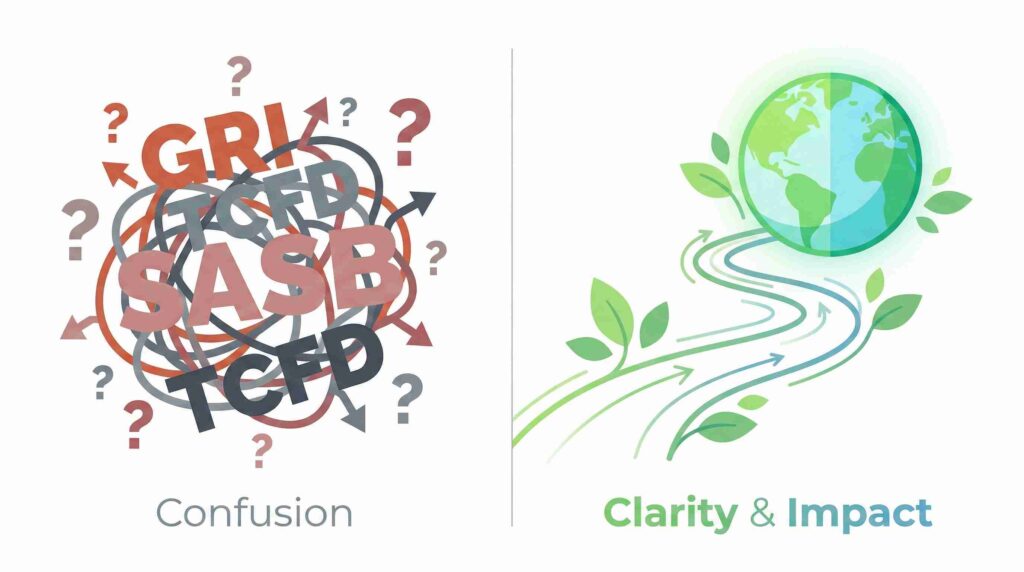
Fig 1: Illustration contrasting the confusion of multiple ESG acronyms with a streamlined, clear path to sustainability impact (AI generated)
Sustainable Solutions: Navigating the New Normal
The good news? The chaos is settling. We are seeing a convergence of standards that is making sustainability actionable. Here are three strategies and frameworks that are defining the solution space.
1. The “Double Materiality” Approach (GRI + ISSB)
The most effective strategy today is adopting a “Double Materiality” mindset. This means looking at the world through two lenses:
- Financial Materiality (Inwards): How do climate change and social issues impact the company’s finances? The International Sustainability Standards Board (ISSB), which has absorbed the principles of SASB and TCFD (Task Force on Climate-related Financial Disclosures), is now the gold standard here.
- Impact Materiality (Outwards): How does the company impact the world? The Global Reporting Initiative (GRI) remains the leader for this stakeholder-centric view.
Actionable Step: If you are a business leader, stop choosing between these. Use ISSB to talk to your investors and GRI to talk to your customers and community. They are complementary, not competing.
2. Nature as a Critical Asset (TNFD)
We are moving beyond just “carbon” to “nature.” The newly emerging Taskforce on Nature-related Financial Disclosures (TNFD) is helping companies assess risks related to biodiversity loss.
- Why it matters: Over half of global GDP depends on nature. If you are in agriculture, textiles, or construction, ignoring biodiversity is a financial risk.
Real-World Success Stories
Case Study 1: Europe’s Circular Pioneer – IKEA
IKEA has moved beyond simple reporting to fundamentally changing its business model. Aligning with stringent EU regulations like the CSRD (Corporate Sustainability Reporting Directive), IKEA is aggressively pursuing “circularity” (IKEA sustainability).
The Win: They are testing rental and repair services, aiming to make all products from renewable or recycled materials by 2030.
The Lesson: Compliance is not just about ticking boxes; it can drive innovation. By preparing for stricter rules, IKEA is future-proofing its supply chain against resource scarcity.
Case Study 2: India’s Tech Leader – Infosys
In India, the BRSR (Business Responsibility and Sustainability Reporting) mandate by SEBI has pushed top companies to be more transparent. Infosys stands out by integrating ESG into its core governance.
The Win: They achieved carbon neutrality decades ahead of the Paris Agreement timeline by investing heavily in renewables and community-based offsets.
The Lesson: In emerging markets, leading on ESG attracts global capital. Infosys uses its strong ESG rating to differentiate itself to global clients who demand sustainable partners.
Challenges and Future Outlook: The Road to 2030
While the path is clearer, it is not smooth. We face significant headwinds that require resilience and foresight.
The Barriers
- The “Anti-ESG” Political Backlash: Particularly in the U.S., ESG has become politicized. This “fragmentation” means companies operating globally must navigate ambitious pro-ESG rules in Europe (like the CSRD) while tiptoeing around political minefields in other regions.
- The Cost of Compliance: Implementing robust data tracking systems (like AI-driven carbon accounting) is expensive. Small and medium enterprises (SMEs) often struggle to keep up with the reporting demands of their larger corporate partners.
Trends and & Predictions for 2030
Despite these hurdles, the momentum is unstoppable. Here is what I see coming by 2030:
- Integrated Reporting is the Norm: We will stop seeing separate “Sustainability Reports.” ESG data will be fully integrated into Annual Financial Reports, audited with the same rigor as revenue figures.
- Scope 3 Transparency: AI and blockchain will finally crack the code on supply chain tracking, making it impossible for companies to hide their carbon footprint in their supply chain.
- Mandatory vs. Voluntary: The days of voluntary disclosure are ending. Regulations like the EU’s CSRD and California’s climate laws will set a global baseline that affects everyone, regardless of where they are headquartered.
Conclusion: Your Role in the Green Transition
The evolution of ESG frameworks from a confusing alphabet soup to a structured, mandatory system is a sign of a maturing market. We are moving from saying we care to proving it. Whether it’s the financial rigor of the ISSB, the impact focus of GRI, or the nature-positive lens of TNFD, these tools are building a transparent economy where capital flows to the most sustainable solutions.
But this isn’t just a corporate game. You have power too. Here are three easy ways you can contribute today:
- Check Your Pension: Ask your fund manager if they offer “ESG” or “Sustainable” fund options. Your retirement savings are a powerful vote for the future you want.
- Support Transparency: Buy from brands that publish clear, audited sustainability reports (look for B-Corp certification or GRI-referenced reports).
- Stay Educated: Read theUN Sustainable Development Goals (SDGs) to understand the global targets we are all striving for.
Resources
Bloomberg Intelligence (22/02/2024). ‘ESG AUM set to top $40 trillion by 2030, anchor capital markets’. Available at: https://www.bloomberg.com/professional/insights/sustainable-finance/esg-aum-set-to-top-40-trillion-by-2030-anchor-capital-markets/ (Accessed on 17/01/2026).
IKEA Sustainability. Available at: https://www.ikea.com/global/en/our-business/sustainability/our-circular-agenda/ (Accessed on 20/01/2026).
World Business Council for Sustainable Development (23/06/2025). ‘Governments with clear net-zero policies capitalize on global business investment, new report finds’. Available at: https://www.wbcsd.org/news/governments-with-clear-net-zero-policies-capitalize-on-global-business-investment-new-report-finds/ (Accessed on 17/01/2026).